
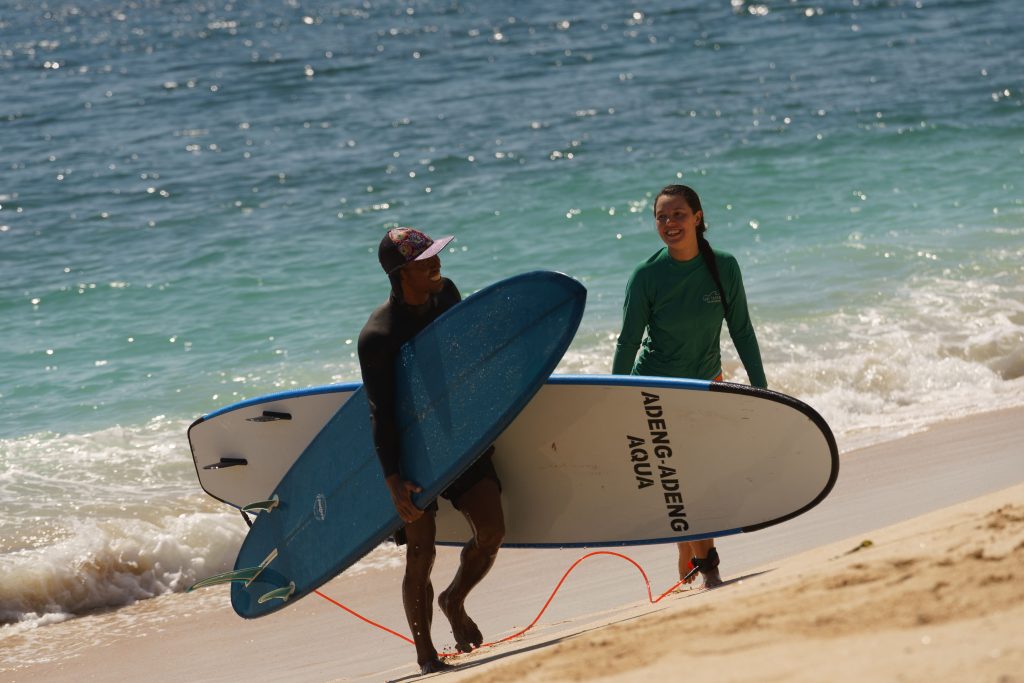
Every surfer remembers their first session — the wobbly pop-ups, the mouthfuls of saltwater, the one wave that actually worked and made the whole thing worth it. If you’re about to have that first session yourself, here’s everything I make sure my students understand before they ever touch the water, condensed into one guide.
Surfing Is Simpler to Start Than It Looks
Watching someone carve a wave on Instagram makes surfing look impossibly hard. Here’s the truth: your first session isn’t about carving anything. It’s about three basic skills — lying on a board, paddling, and standing up — and every surfer on earth started exactly there. Progress in surfing comes in stages, and stage one is simply about getting comfortable being in the ocean on a board. Don’t judge your first session against a highlight reel; judge it against yesterday, when you’d never stood on a surfboard at all.
Do You Need to Be Fit to Surf?
You don’t need to be an athlete, but a baseline of comfort in the water helps enormously — mainly because paddling is more physically demanding than people expect. It uses your shoulders, back, and core in a sustained, repetitive way that’s different from most everyday movement.
A few practical notes:
- You should be a reasonably confident swimmer. You don’t need to be fast, but you need to be comfortable in moving water.
- A short warm-up before paddling out genuinely helps. A few minutes of light jogging or jumping jacks, some arm circles and shoulder rolls, a few trunk rotations, and a couple of deep squats go a long way toward loosening the shoulders and hips you’re about to load up.
- Don’t stretch cold, static muscles right before paddling out — save the long, held stretches for afterward, once you’re warmed up. Before you paddle out, you want movement, not static stretching.
- Fitness will come with time. Paddling endurance builds fast once you’re in the water regularly — most beginners feel a noticeable difference by their third or fourth session.
What Gear Do You Actually Need for Your First Session?
If you’re taking a lesson, most of this will be provided — but it helps to understand why you’re being handed the equipment you are.
- A big, soft board. First-timers should ride a larger-volume board than they think they need. More foam means the board floats higher and catches waves earlier, which means more waves ridden and fewer exhausting near-misses. A soft-top (foam) longboard is the standard first-timer choice — it’s stable, forgiving, and won’t hurt you (or anyone else) if it hits you.
- A leash matched to your board. This keeps your board attached to your ankle so it doesn’t wash away — or worse, become a hazard to someone else — every time you fall.
- Wax or a traction pad. Surfboards are slippery without it. Wax gets applied in a crosshatch pattern to create grip for your feet.
- A rash guard. Beyond sun protection, it prevents the chest and stomach rash that comes from friction against the board — often called “wax rash” or “board rash,” and every beginner learns about it the hard way if they skip this.
- Reef booties, if you’re surfing anywhere with a rocky or reef bottom. Not every beach needs them (a sandy beach break doesn’t), but they’re essential at rockier or reef spots.
- Reef-safe sunscreen — and reapply it. Near the equator, sun exposure is intense, and a two-hour session is enough to burn skin that’s normally fine at home.
Understanding a Wave (Just Enough to Get You Started)
Your instructor is going to use a few terms constantly, so it helps to know them before you’re bobbing in the water trying to figure out what “the shoulder” means:
- Whitewater — the frothy, broken part of a wave after it’s already collapsed. This is where every beginner starts, and it’s genuinely the best training ground for balance and the pop-up, since it forgives mistakes.
- The face (or wall) — the smooth, unbroken part of the wave, still standing up, not yet collapsed.
- The peak — where the wave is breaking hardest and first.
- The shoulder — the softer, lower part of the wave tapering away from the peak.
- The pocket — the steepest, most powerful section, right next to where the wave is breaking. More advanced surfers aim to ride close to it; beginners aren’t chasing this yet.
For your first sessions, you’ll be almost entirely focused on catching whitewater, not the open face — and that’s exactly the right place to build from.
The Two Skills That Matter Most on Day One
Paddling comes first, and it’s mostly about positioning. Lie centered on the board with your chest slightly lifted (imagine a gentle arch through your back), rather than flat and sunk in the middle — this keeps the nose from digging into the water and keeps you gliding rather than dragging. Reach forward and pull your arms back in a steady alternating stroke, close to the rail of the board rather than out wide.
The pop-up is the movement from lying down to standing up, and it happens in one motion, not several. As the wave picks you up, place your palms flat on the board near your ribs (not grabbing the rails), push up explosively through your arms, and drive your hips and knees forward underneath you in a single motion, landing with your feet already in a low, bent-knee stance — front foot centered, angled forward, back foot near the tail. Eyes stay up, looking where you want to go, not down at your feet or the nose of the board.
Most beginners try to stand up in stages (knees first, then slowly rise) — and it almost never works, because you lose your balance in transition. One committed, explosive motion works far better than a cautious one, even though it feels counterintuitive at first.
Basic Ocean Safety Every First-Timer Should Know
This is the part that matters most, and it’s worth reading twice.
If you wipe out, don’t panic. A hold-down under a wave typically lasts somewhere between a few seconds and, at the very most, around 15 seconds — even though it can feel much longer. Staying relaxed rather than thrashing actually helps your body conserve oxygen and ride it out more comfortably. If you feel your face go into the water, your body’s natural response is actually to slow your heart rate slightly — working with that instinct, not against it, helps.
Learn to fall safely. If you’re in shallow water or anywhere with a rocky or reef bottom, don’t dive headfirst and don’t put your feet down to catch yourself. Fall flat, arms and legs spread (think “starfish”), and cover your head with your arms until you resurface. This spreads the impact and keeps you from driving a limb into anything below you.
Know what a rip current is and how to get out of one. If you ever feel yourself being pulled steadily away from shore or sideways along the beach in a channel of moving water, don’t fight it by swimming straight back toward the beach — you’ll exhaust yourself. Instead, swim sideways, across the current, until you’re free of it, then head in.
Hold onto your board. It’s tempting to let go of your board when a wave is about to hit you, but that turns your board into a projectile for anyone paddling behind you (and it can come straight back at you on the leash). Learn to push the board underwater and let the wave pass over you instead — a coach will teach you this properly.
Respect the sun and your hydration. More beginners get taken out by sunburn and dehydration than by the waves themselves. Reapply sunscreen, wear a rash guard, and drink water before and after your session — not just when you’re thirsty.
If you’re surfing anywhere near a river mouth, be extra cautious after heavy rain. Runoff can carry bacteria into the surf zone for a day or two after a big storm, so it’s worth avoiding those spots right after wet weather.
Lineup Etiquette 101
The “lineup” is where surfers sit waiting for waves, and it has unwritten rules that keep everyone safe:
- Whoever is closest to where the wave is breaking has priority for that wave. Everyone else waits.
- Never take off in front of someone who’s already riding — this is called “dropping in,” and it’s the number one cause of collisions and hard feelings in the water.
- Don’t paddle around behind someone to jump ahead in the rotation (“snaking”) — wait your turn.
- Paddle out around the side, through the channel, not straight through where everyone’s catching waves.
- If you’re caught in the impact zone with a wave coming, push your board underwater and let the whitewater pass over you, rather than paddling straight through someone’s path.
As a beginner, most of your early sessions should be in gentle whitewater away from a crowded, competitive peak anyway — but knowing these rules early will make you a welcome presence in the water as you progress.
Where Should You Take Your First Lesson?
Not every beach is a good place to learn. The best beginner spots share the same features: a soft, sandy bottom (no reef or rocks to worry about), gentle rolling whitewater rather than powerful barreling waves, and enough space that you’re not competing with experienced surfers for the same wave.
In Bali, the classic first-timer zones are the wide, sandy stretches of Kuta and Seminyak Beach, and the calmer, more sheltered bays like Jimbaran Bay — a protected, west-facing bay that stays gentle even when the more exposed coastline is pumping. These spots exist for exactly this reason: room to fall, nothing sharp underneath you, and waves that forgive mistakes.
Should You Take a Lesson, or Try to Teach Yourself?
You can technically teach yourself to surf. I’d still recommend against it for your first session, and here’s the honest reason why: a coach isn’t just there to explain the pop-up — they’re reading the ocean for you. Picking the right day, the right tide, the right peak, and keeping you positioned safely relative to currents and other surfers is exactly the kind of judgment that takes years to build and seconds to get wrong. A good first lesson typically saves people weeks of frustrating, wave-less trial and error, and — more importantly — keeps that first experience safe and genuinely fun instead of overwhelming.
What to Expect From Your First Session
Be honest with yourself about this going in: you probably won’t stand up on your very first wave, and that’s completely normal. Most first-timers spend a good chunk of their first session simply getting comfortable lying on the board, paddling, and timing their pop-up in whitewater. Standing up — even briefly — on your first day is a genuine win. Riding a few waves cleanly usually comes with your second or third session, not your first.
What does usually happen in a first lesson: you leave with a real feel for paddling, a couple of successful pop-ups (even if wobbly), a much better understanding of the ocean around you, and — almost universally — the urge to go again.
Final Word from Your Coach
Every surfer you’ll ever watch effortlessly gliding across a wave started exactly where you’re about to start: face-down on a board, unsure which way to paddle. The ocean rewards patience far more than it rewards power or athleticism. Come with realistic expectations, respect for the water, and a willingness to fall a lot — the rest follows.
Ready for your first session? At Surf Journey Bali, we start every beginner in the right conditions, at the right spot, with a coach right beside you in the water — so your first day in the surf is safe, well-guided, and genuinely fun.

Yosua is a surf enthusiast with over 5 years of chasing waves across Bali’s iconic coastlines. From West coast to East coast of Bali, he’s spent years exploring what makes Bali one of the world’s greatest surf destinations. Through Surf Journey Bali, Yosua shares honest guides, local tips, and surf travel insights to help both beginners and seasoned wave-riders make the most of their Bali surf experience.