

If you’re weighing up an active vacation, here’s the short answer: yes, surfing is a genuinely effective way to get fitter and support weight loss — but not for the reason most people expect. It’s not really about how many calories a single session torches. It’s that surfing happens to combine several different types of exercise into one activity you’ll actually want to keep doing, which is the real key to any lasting fitness result.
A Full-Body Workout Disguised as Fun
Surfing places some unusual demands on the body compared to typical gym exercise. A single session combines sustained isometric core and spinal engagement during paddling, explosive, plyometric power output during every pop-up, and high-velocity rotational loading during turns. That’s a cardio workout, a strength workout, and a mobility workout, all layered into the same hour — without ever feeling like “exercise” in the way a treadmill does.
The Muscles You Didn’t Know You Were Using
Ask anyone after their first lesson and they’ll tell you: it’s not your legs that are sore the next day, it’s everywhere.

- Paddling works your shoulders, lats, rhomboids, and rear deltoids through continuous, repetitive pulling, while your lower back and core hold a sustained isometric brace to keep your chest lifted off the board.
- The pop-up is a short, explosive burst through your chest, triceps, and core — closer to a plyometric exercise than a slow strength movement.
- Standing and turning engages your glutes, hip flexors, and adductors as you hold a low, athletic stance and shift weight through your hips.
- Balance itself recruits small stabilizer muscles throughout your legs, ankles, and core that most gym routines rarely target directly.
Very few single activities ask this much of this many muscle groups in one session — which is exactly why a couple of hours of surfing tends to leave you more thoroughly tired than an equivalent gym workout.
So, How Many Calories Does It Actually Burn?
It varies quite a bit depending on wave size, session intensity, and how much time you spend paddling versus resting between sets — but as a general guide, most surfers burn somewhere in the range of 250 to 450 calories per hour, with bigger, more demanding conditions pushing that figure higher still. Heavier surf, more paddling, and more wave attempts all increase the number; a slow, mellow session with lots of waiting between waves will sit toward the lower end.
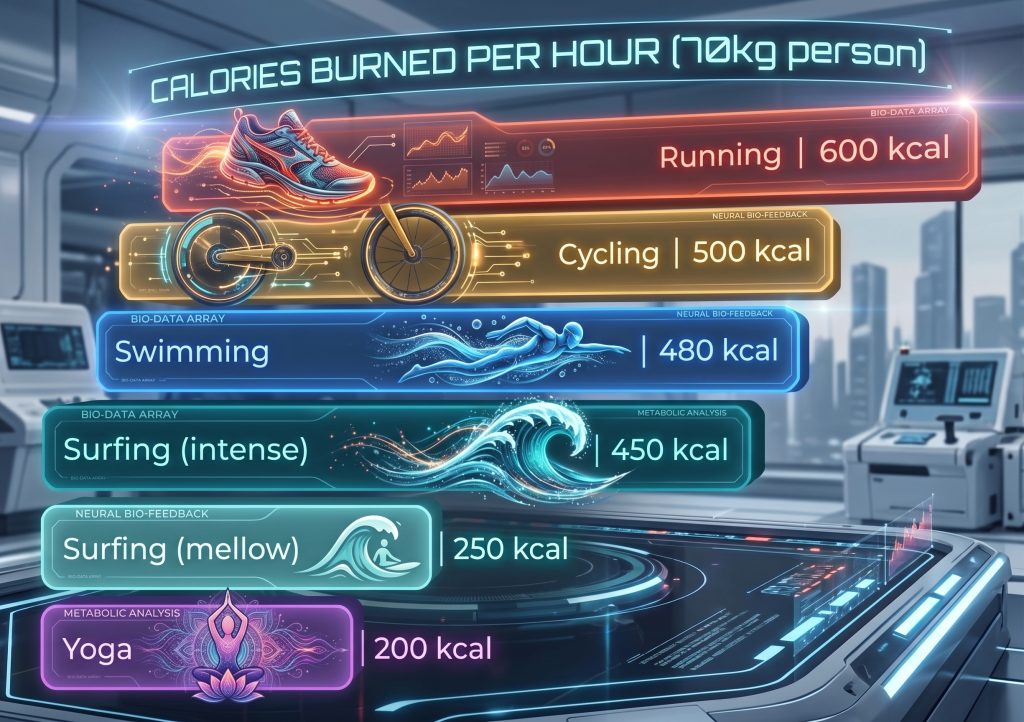
The honest takeaway is that surfing isn’t necessarily the single highest calorie-burning activity available — running or cycling at full intensity can outpace it. What surfing has going for it instead is something more valuable for actual, lasting results.
Why Surfing Beats a Gym Routine for Most People
The biggest factor in any fitness outcome isn’t the intensity of one session — it’s whether you keep showing up. A brutal workout you dread doing once a week will always lose to a moderate one you’re excited to do four times a week, and surfing has a genuine advantage here: it’s fun in a way that makes consistency easy rather than something you have to force.
It’s also low-impact. The water supports your body weight, meaning far less joint stress than running or many gym-based cardio options, which makes it realistic to do repeatedly across several consecutive days without the recovery penalty a high-impact workout would demand.
Making the Most of a Surf Trip
If getting fitter is part of why you’re planning a Bali trip, structure matters. A single one-off lesson will leave you sore and happy, but it won’t move the needle much on fitness. A multi-day package — several sessions across a week, paddling and popping up repeatedly each day — builds real cardiovascular and muscular conditioning the same way any consistent training block would. It also happens to be exactly how surf skill develops fastest too, so the fitness benefit and the skill benefit compound together rather than competing for your time.
Beyond the Number on the Scale
It’s worth zooming out from calories entirely for a moment. Regular surfing builds genuine functional strength and cardiovascular endurance, improves balance and coordination, and gets you outside in the sun and salt water — which plenty of people find does as much for stress and mental wellbeing as it does for the body. Weight loss is one possible outcome of consistent surfing, but it tends to arrive as a side effect of building a habit you actually enjoy, rather than something you have to grind for.
The Bottom Line
Surfing won’t out-burn a hard interval run on paper, but it wins where it counts: it’s a genuine full-body workout wrapped inside something people are far more likely to actually stick with. Book several consecutive days rather than a single session, and you’ll leave Bali not just having learned to surf, but having put in a real, structured stretch of physical conditioning — one that felt like a vacation the whole time.
Thinking about building fitness into your trip? A multi-day lesson package is the most effective way to combine real physical results with genuine progress in the water.

Yosua is a surf enthusiast with over 5 years of chasing waves across Bali’s iconic coastlines. From West coast to East coast of Bali, he’s spent years exploring what makes Bali one of the world’s greatest surf destinations. Through Surf Journey Bali, Yosua shares honest guides, local tips, and surf travel insights to help both beginners and seasoned wave-riders make the most of their Bali surf experience.