
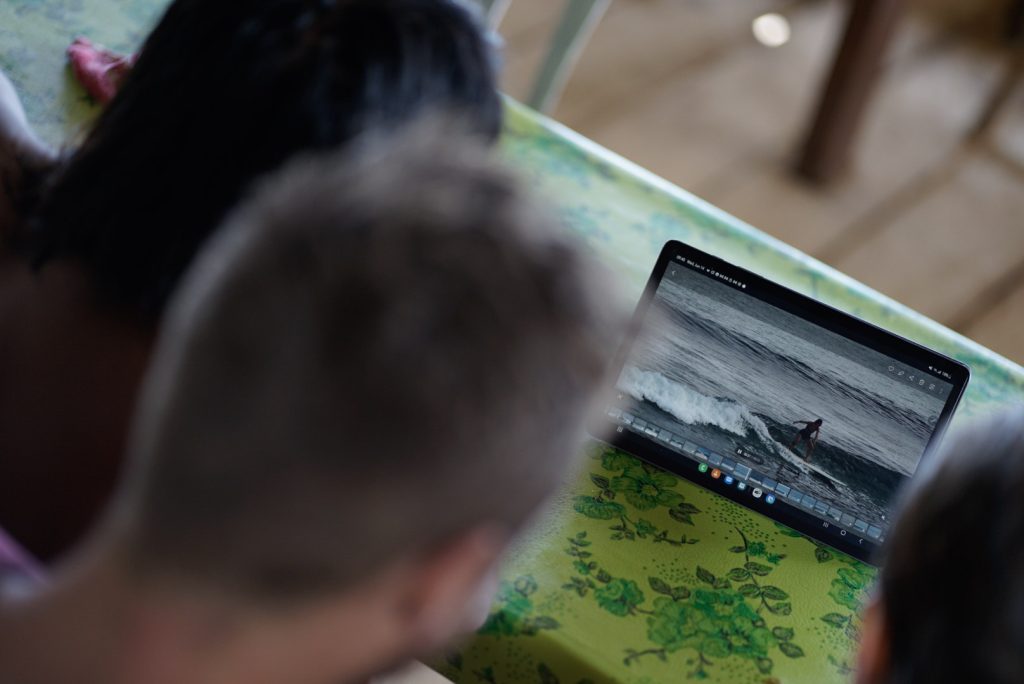
Every surfer has made every mistake on this list — including your instructor. The good news is that almost all of them come down to a handful of fixable habits, not a lack of natural ability. Here are the ten most common beginner mistakes, why they happen, and exactly how to correct them.
1. Looking Down at Your Feet
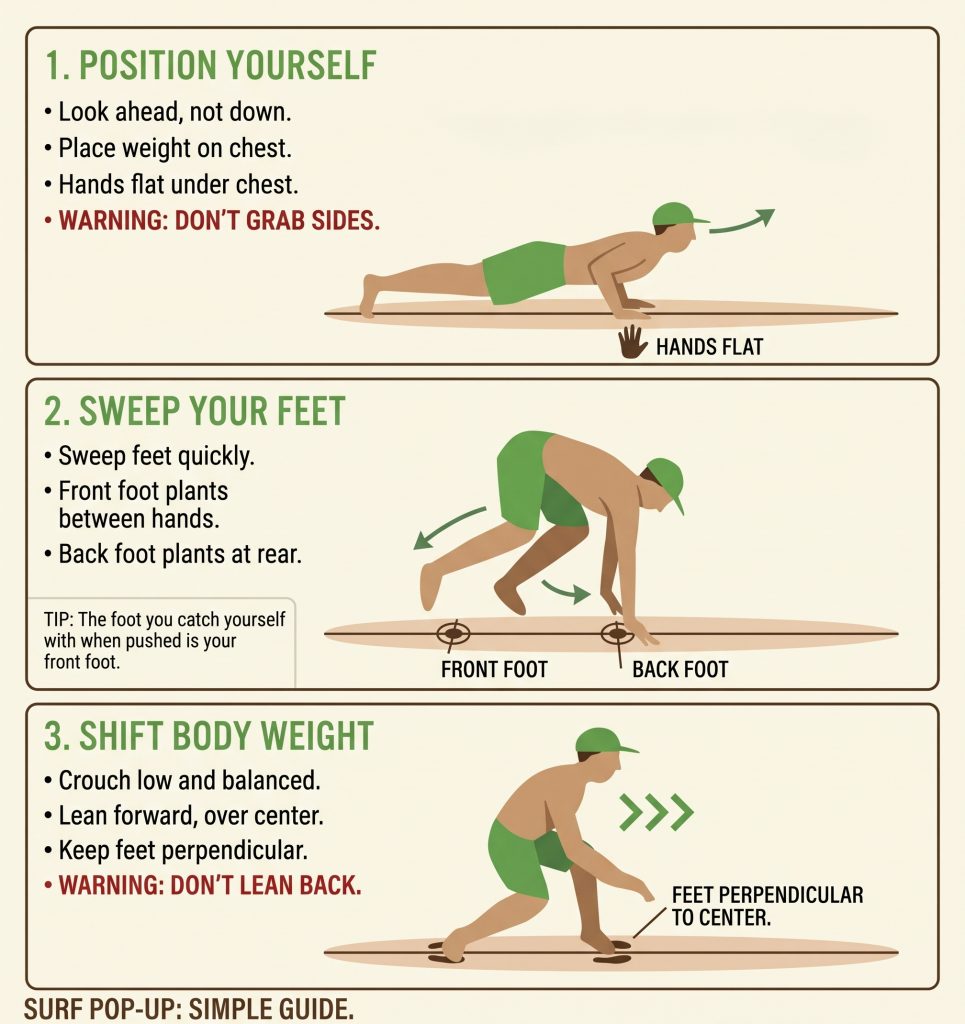
- The mistake: The instant most beginners pop up, their eyes drop straight to their feet to check their footing.
- Why it happens: It feels safer to look at what you’re standing on, especially when balance still feels shaky.
- The fix: Keep your eyes up, focused forward along the wave rather than down at the board’s nose. Your body naturally follows your gaze — look down, and you’ll pitch forward; look ahead, and your balance follows your line of sight instead.
2. Grabbing the Rails During the Pop-Up
- The mistake: Gripping the outer edges of the board while pushing up to stand.
- Why it happens: It feels more secure to hold onto something solid.
- The fix: Plant your palms flat on the deck beside your lower ribcage instead. Grabbing the rails actually destabilizes the pop-up, throwing off your pitch right as you need the most control.
3. Standing Up in Two Steps
- The mistake: Pushing up to your knees first, pausing, then standing — rather than moving straight from lying down to a standing stance in one motion.
- Why it happens: Standing all at once feels like a big leap when you’re still building confidence.
- The fix: The pop-up is meant to be one explosive, continuous motion — hands down, hips and feet driving forward together, landing directly in your stance. The two-step version actually costs you the momentum and timing the wave gives you, making it harder to catch, not easier.
4. Lying in the Wrong Spot on the Board
- The mistake: Paddling too far back (dragging the tail) or too far forward (causing the nose to dig into the water, known as “pearling”).
- Why it happens: Without a clear reference point, it’s genuinely hard to know where “centered” feels like at first.
- The fix: Lift your chest slightly, keeping your lower ribs pressed against the board — this centers your weight correctly over the board’s natural balance point and stops the nose from diving or the tail from dragging.
5. Riding a Board With Too Little Volume
- The mistake: Choosing (or being handed) a smaller, sleeker board before you’re ready for it.
- Why it happens: Smaller boards look more like “real” surfing, and there’s a temptation to size down before your skill catches up.
- The fix: Beginners need extra float — a higher-volume board sits higher in the water, catches waves earlier, and gives you a far more stable platform to build your pop-up on. Sizing down too early just means more paddling for fewer waves caught.
6. Letting Go of Your Board
- The mistake: Ditching the board when a wave looks intimidating, rather than holding on.
- Why it happens: Pure instinct — it feels safer to let go and duck under than to stay attached to something big and unwieldy.
- The fix: Hold on and duck-dive or turtle-roll under the wave instead. A loose board becomes a projectile that can genuinely injure someone behind you — this is a real safety habit, not just a technique preference.
7. Paddling Straight Through the Crowd
- The mistake: Paddling directly out through the main takeoff zone, where everyone else is trying to catch waves.
- Why it happens: It’s often the most direct-looking path to the lineup.
- The fix: Paddle out wide, using the channel to the side of the main peak. It’s a longer route, but it keeps you clear of other surfers’ waves and out of the busiest, most collision-prone water.
8. Panicking During a Wipeout
- The mistake: Thrashing and fighting the moment you’re held underwater.
- Why it happens: It’s a natural fight-or-flight response — your instincts want you swimming for the surface immediately.
- The fix: Consciously relax instead. Most hold-downs last somewhere between 6 and 12 seconds, rarely more than 15 — far shorter than panic makes it feel. Relaxing lets your body’s natural calming reflex do its job, while thrashing just burns through your oxygen faster.
9. Fighting Directly Against a Rip Current
- The mistake: Paddling straight back toward shore when caught in a rip.
- Why it happens: Shore feels like safety, so swimming toward it feels like the obvious move.
- The fix: Paddle perpendicular to the current instead, cutting sideways toward the breaking peak rather than fighting the pull head-on. A rip is often stronger than you can paddle against directly — working across it, not against it, is what actually gets you out.
10. Skipping the Warm-Up (Or Doing the Wrong Kind)
- The mistake: Either heading straight into the water cold, or doing static stretches — holding a toe-touch or a long quad stretch — beforehand.
- Why it happens: Static stretching is the default most people learned for other sports, so it feels like the “correct” way to prepare.
- The fix: Use dynamic movement instead — arm circles, torso rotations, light jogging. Static stretching actually reduces power output right afterward, which is the opposite of what a session full of explosive pop-ups and paddling demands.
The Bottom Line
Nearly every one of these mistakes comes from instinct working against you rather than a lack of effort — your body reaching for what feels safe in the moment, even when it’s actually working against your balance, your timing, or your safety. Knowing the fix ahead of time means you’re not learning it the hard way, one wipeout at a time.
Want a coach to catch these in real time, before they become habits? Book a lesson with us and we’ll help you build the right patterns from your very first wave.
Yosua is a surf enthusiast with over 5 years of chasing waves across Bali’s iconic coastlines. From West coast to East coast of Bali, he’s spent years exploring what makes Bali one of the world’s greatest surf destinations. Through Surf Journey Bali, Yosua shares honest guides, local tips, and surf travel insights to help both beginners and seasoned wave-riders make the most of their Bali surf experience.