
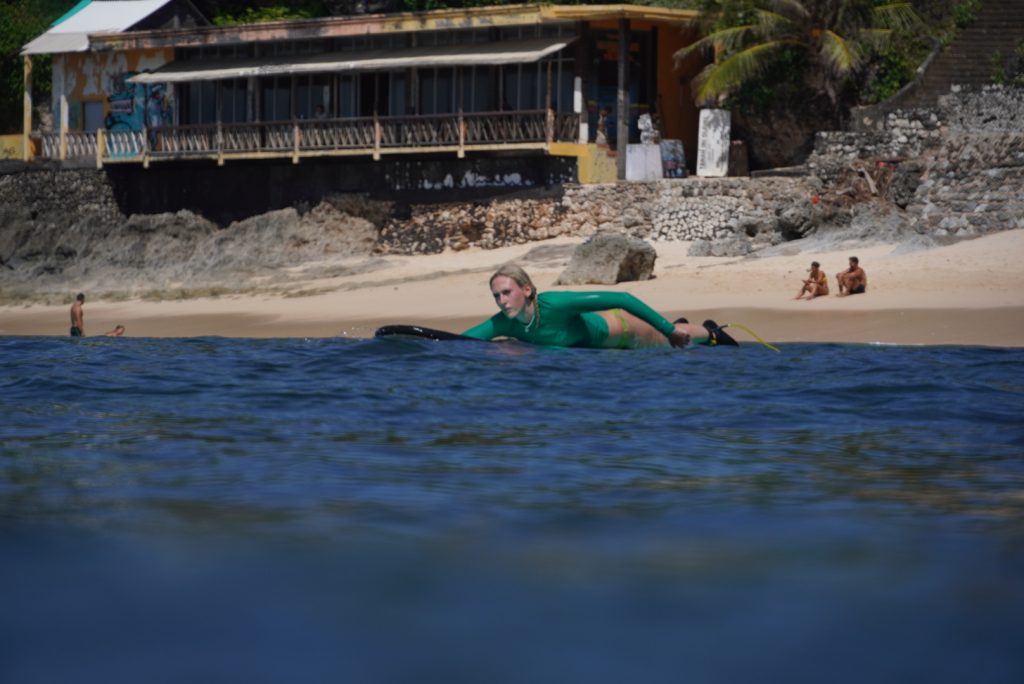
Ask any beginner what wore them out fastest on their first day, and it’s rarely the pop-up. It’s paddling. Your arms feel like jelly within twenty minutes, and it’s tempting to blame fitness — but the real issue is almost always technique, not strength. Fix the technique, and paddling stops being the exhausting part of your session.
Why Paddling Wears Beginners Out So Fast
Here’s what’s actually happening in your body while you paddle, and it explains a lot: paddling demands continuous isometric contraction through your thoracic erectors — the muscles running along your spine — held tight the entire time you’re prone, layered on top of repetitive, dynamic pulling through your lats, rhomboids, and rear deltoids with every single stroke. That’s two different, demanding types of muscular work happening simultaneously, non-stop, for as long as you’re paddling. It’s not just an arm workout — your whole posterior chain is under sustained load the entire time, which is exactly why beginners gas out faster than they expect.
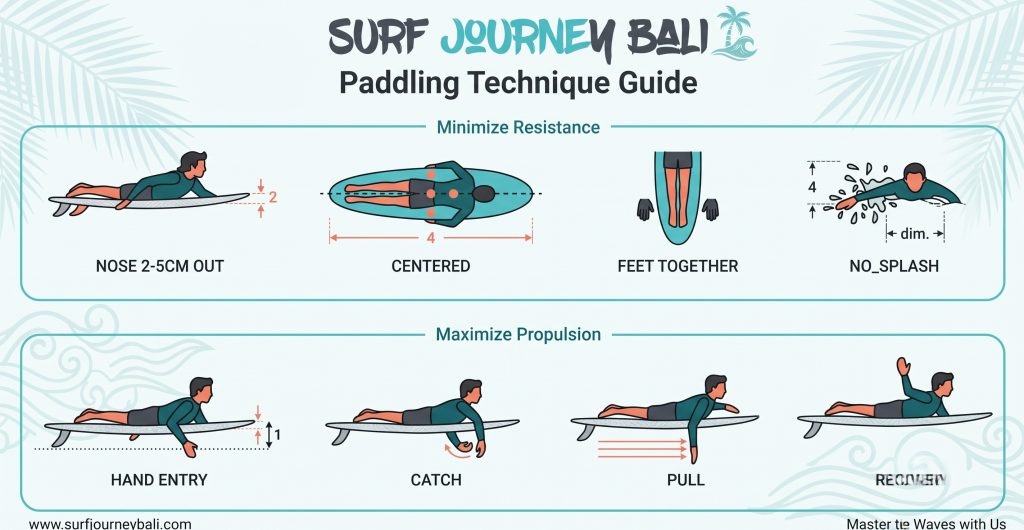
Poor technique makes this dramatically worse, not just less efficient. Fighting a badly positioned board, or splashing through sloppy strokes that don’t actually convert into forward motion, means you’re spending all that same muscular effort for a fraction of the payoff.
The Position That Changes Everything
Before your arms even enter the water, your body position on the board determines how much work you’re about to make yourself do. The correct prone position holds your thoracic spine in a slight hyperextension — chest and sternum lifted off the deck, while your lower ribs stay pressed against the board. This isn’t just posture for its own sake: it centers your body weight directly over the board’s buoyant center, which stops two energy-wasting problems at once — the nose digging into the water (pearling) and the tail dragging and creating excess wake. Both of those act like a brake, quietly working against every stroke you take.
The Stroke Itself
Propulsion comes from an alternating, deep underwater stroke path — not a shallow, splashy paddle across the surface. Your hand should enter the water cleanly, with minimal splash, and pull close along the board’s centerline (the stringer) rather than out wide to the side. A wide, splashy stroke feels like effort, but a lot of that energy is being wasted sideways instead of driving you forward. Pulling in tight along the centerline converts far more of your actual muscular effort into the thing you actually want: forward momentum.
Timing Matters As Much As Technique
Good paddling isn’t just about the stroke itself — it’s about getting your position, rhythm, and stroke pace fully established before the incoming swell actually lifts your tail. Scrambling to get positioned at the last second means you’re paddling reactively rather than with any real rhythm, which burns more energy for a worse result. Watch the wave, start paddling early, and let your stroke rhythm build smoothly into the moment the wave actually picks you up.
Choosing a Board That Paddles Easier For You
Technique matters most, but your equipment is doing real work too. Soft-top foam construction is specifically built to maximize paddle float for beginners — more of the board sits above the waterline, meaning less drag to fight against. A flatter rocker (the curve of the board from nose to tail) increases glide and paddle speed, which is exactly why beginner boards are shaped this way rather than with the curved rocker built for steep, advanced waves. And board volume matters directly here too: a higher-volume board sized correctly for your body weight rides higher in the water, meaningfully reducing how hard you have to work to reach the same paddling speed as someone fighting an undersized board.
If paddling is wearing you out faster than it should, it’s worth checking whether the board itself is part of the problem, not just your technique.
Building Paddle Endurance Off the Water
If you know you’ve got a surf trip coming and want to arrive with more in the tank, a few targeted exercises genuinely translate to paddle endurance: high-volume interval swimming, prone bench pulls, and resistance-band external rotations all target the exact posterior chain and shoulder stamina paddling demands. None of this is required to start surfing, but if you’re the type who likes to prep ahead of a trip, this is where that preparation actually pays off in the water.
A Quick Mental Trick for the Paddle Out
One small addition worth knowing: box breathing — inhaling for 4 seconds, holding for 4, exhaling for 4, holding empty for 4 — practiced before you paddle out helps regulate your effort and keep you from paddling anxiously and inefficiently the moment you hit the water. A calm start to your paddle out tends to be a more efficient one too.
The Bottom Line
Exhausting paddling almost always comes down to fighting your own position, your stroke, or your board rather than a lack of raw fitness. Get your chest lifted and centered, keep your stroke tight along the centerline, time your effort to the wave rather than scrambling late, and make sure your board is actually built to help you rather than against you. Get those right, and you’ll find yourself with far more energy left for the part you actually came for — standing up and riding.
Want a coach to fine-tune your paddling technique in real time? Book a lesson with us and we’ll have you paddling efficiently, not just paddling hard.

Yosua is a surf enthusiast with over 5 years of chasing waves across Bali’s iconic coastlines. From West coast to East coast of Bali, he’s spent years exploring what makes Bali one of the world’s greatest surf destinations. Through Surf Journey Bali, Yosua shares honest guides, local tips, and surf travel insights to help both beginners and seasoned wave-riders make the most of their Bali surf experience.