
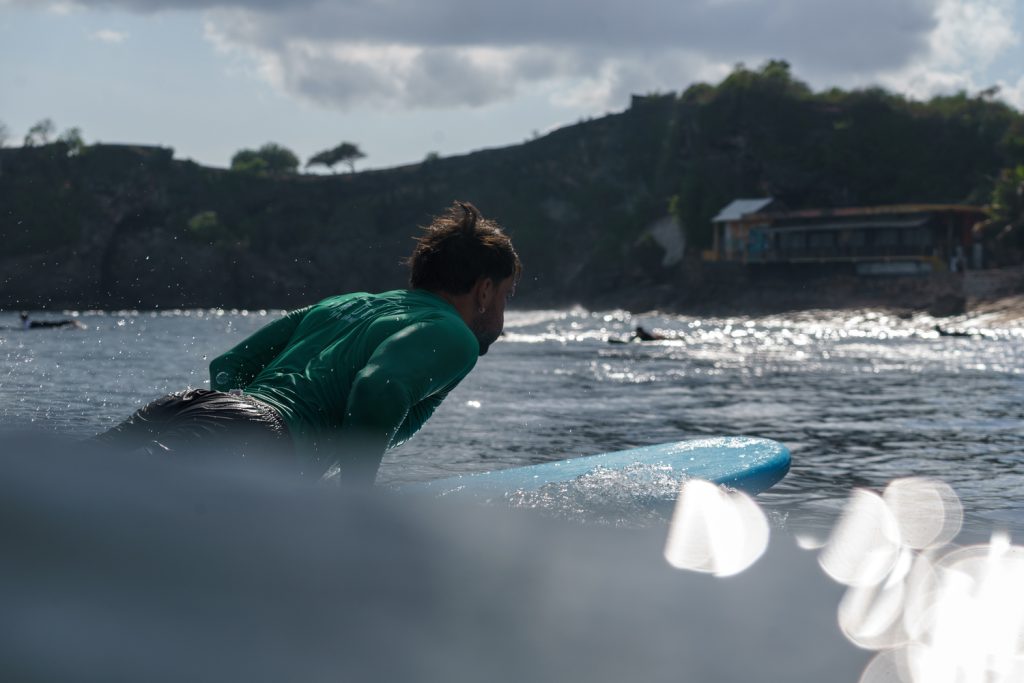
The pop-up is the single movement that decides how the rest of your wave goes — and it’s also one of the only surfing skills you can genuinely train before you ever touch the water. If you’ve got a few weeks before your trip, here’s exactly how to spend them.
What a Correct Pop-Up Actually Looks Like
Before training the movement, it’s worth knowing precisely what you’re training toward. A proper pop-up is one continuous, explosive motion — not a two-stage stand where you pause on your knees first. Your palms plant flat on the deck beside your lower ribcage, deliberately not gripping the rails, which can actually destabilize the transition. From there, you extend forcefully through your chest and triceps while flexing your core, pulling your hips and knees forward beneath your torso in a single coordinated movement. You land softly in a low, athletic stance — bent knees, level hips, upright torso — with your eyes looking forward, not down at your feet.
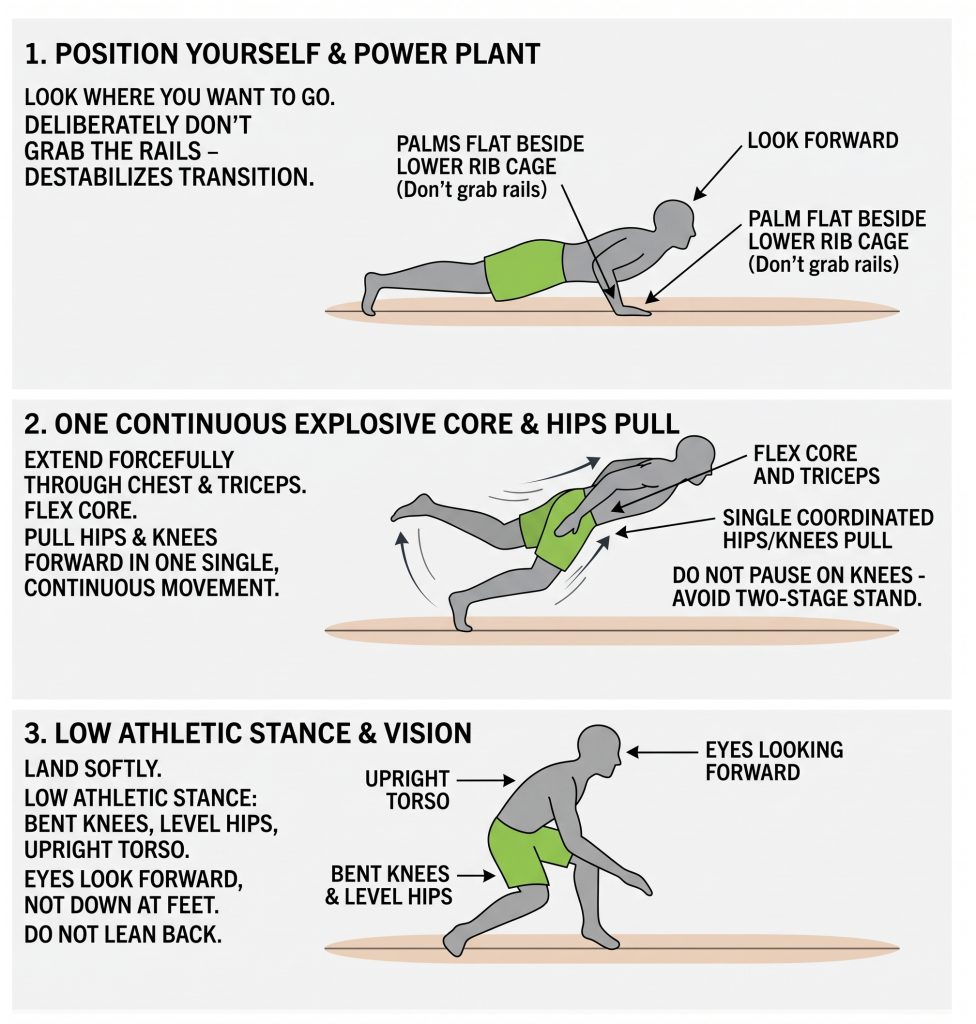
That’s the target. Everything below is built to train your body toward hitting it reliably, under pressure, without thinking about it.
Why Land Training Actually Works
Here’s the real advantage of practicing on sand or a living room floor: there’s no wave rushing you, no water pulling you off balance, no pressure to get it right in half a second. That lets you drill the exact neural pattern — palm placement, the core-driven snap, the landing position — slowly and deliberately, again and again, until it stops requiring conscious thought. This is precisely the same logic behind the dry-land pop-up reps coaches have you do on the sand before every session: repetition without consequence builds the automatic movement pattern that a real wave then simply triggers.
The Core Exercises
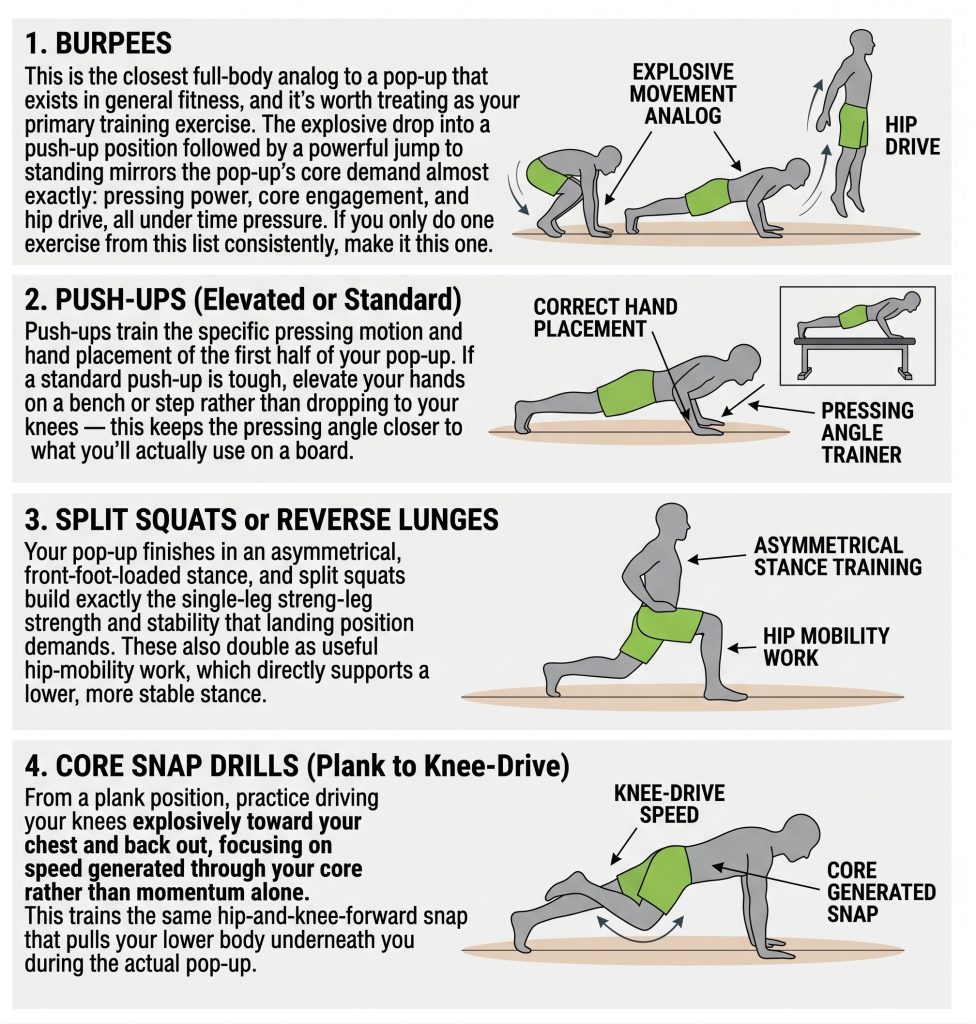
- Burpees This is the closest full-body analog to a pop-up that exists in general fitness, and it’s worth treating as your primary training exercise. The explosive drop into a push-up position followed by a powerful jump to standing mirrors the pop-up’s core demand almost exactly: pressing power, core engagement, and hip drive, all under time pressure. If you only do one exercise from this list consistently, make it this one.
- Push-Ups (Elevated or Standard) Push-ups train the specific pressing motion and hand placement of the first half of your pop-up. If a standard push-up is tough, elevate your hands on a bench or step rather than dropping to your knees — this keeps the pressing angle closer to what you’ll actually use on a board.
- Split Squats or Reverse Lunges Your pop-up finishes in an asymmetrical, front-foot-loaded stance, and split squats build exactly the single-leg strength and stability that landing position demands. These also double as useful hip-mobility work, which directly supports a lower, more stable stance.
- Core Snap Drills (Plank to Knee-Drive) From a plank position, practice driving your knees explosively toward your chest and back out, focusing on speed generated through your core rather than momentum alone. This trains the same hip-and-knee-forward snap that pulls your lower body underneath you during the actual pop-up.
The Taped-Line Drill: Practice the Exact Movement
Here’s a genuinely useful trick worth setting up at home: place a strip of tape in a straight line on a mat or floor to represent your board’s centerline, then add two short horizontal strips where your feet should land in your stance. Practice popping up directly onto those marks. This gives you instant, honest feedback — are your feet landing centered? Too narrow, too wide? Are you having to readjust after landing because your first attempt missed the mark? It’s a small setup that turns vague repetition into precise, self-correcting practice.
A Simple Weekly Structure
You don’t need an elaborate program — consistency matters far more than complexity. A useful template in the weeks before your trip:
- 3 rounds of: 10 burpees, 10 push-ups, 10 split squats per side
- Finish each session with 5 slow, deliberate pop-ups, focusing purely on form rather than speed
Two to three sessions a week in the month before your trip is genuinely enough to make a noticeable difference in how your pop-up feels on your first day in the water.
Quality Over Speed
It’s worth resisting the urge to rush through reps just to get the workout done. A fast, sloppy pop-up trains exactly the habits you don’t want — a two-stage stand, a stiff landing, feet in the wrong position. Slow down, especially on your final few reps each session, and make sure every single one lands in that correct low, bent-knee, eyes-forward stance. The goal isn’t volume for its own sake, it’s grooving the correct pattern so deeply that your body defaults to it automatically once a real wave is involved.
The Bottom Line
You can’t practice catching an actual wave from your living room, but you can absolutely train the exact movement that determines whether you stand up once you’re on one. Burpees, push-ups, split squats, and a few weeks of deliberate, slow repetition will put you noticeably ahead of where most beginners start — meaning less time fumbling with the fundamentals once you’re finally in the water, and more time actually riding.
Ready to put the training to the test? Book a lesson with us and we’ll fine-tune everything you’ve been practicing, right from your first wave.

Yosua is a surf enthusiast with over 5 years of chasing waves across Bali’s iconic coastlines. From West coast to East coast of Bali, he’s spent years exploring what makes Bali one of the world’s greatest surf destinations. Through Surf Journey Bali, Yosua shares honest guides, local tips, and surf travel insights to help both beginners and seasoned wave-riders make the most of their Bali surf experience.