
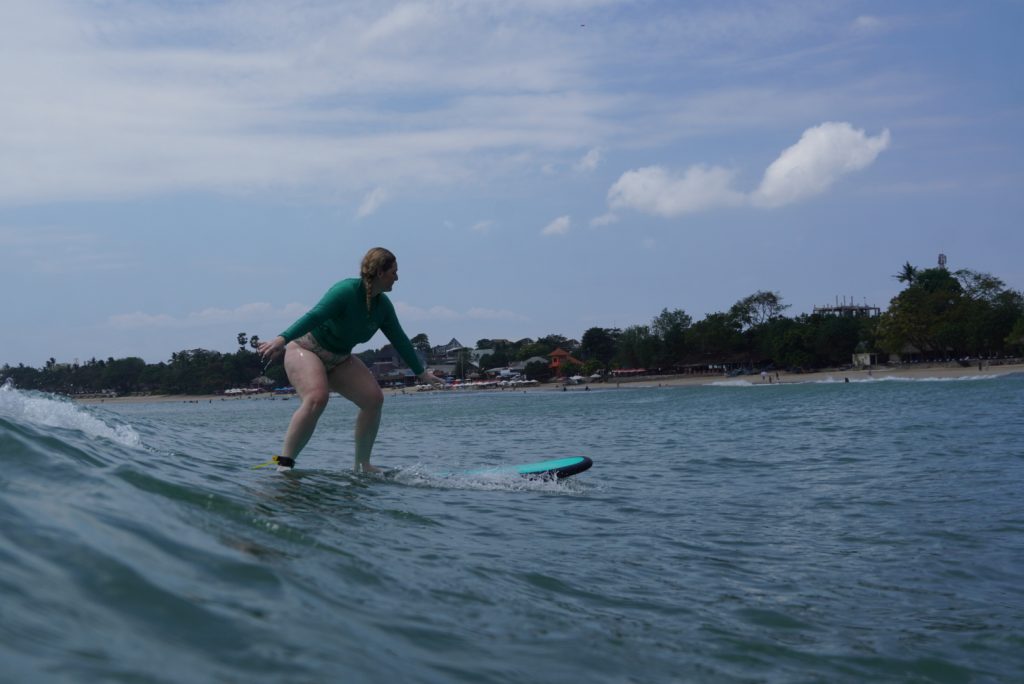
Most beginner surf advice stops at “get a big board.” That’s not wrong, but it’s not precise enough to actually be useful — especially if you’re a heavier beginner who’s been handed generic sizing advice built around an average-weight surfer who doesn’t look much like you. Volume is a measurable, calculable number, not a vague suggestion. Here’s the actual technical guide.
What “Volume” Actually Means
A surfboard’s buoyancy is quantified in liters of displacement — literally, how much water the board pushes out of the way, and therefore how much weight it can support while still riding high on the surface. This single number, more than length or width alone, is what determines whether a board catches waves easily or fights you the entire session.
Why Beginners Need More Volume Than They Think
Here’s the underlying principle worth understanding, not just accepting: for a novice surfer, higher board volume keeps the board riding high on the water, creating a longer effective waterline that glides efficiently into low-energy whitewater and rolling swells. That elevated float ratio is what lets a beginner catch a wave with a few strokes instead of a desperate sprint.
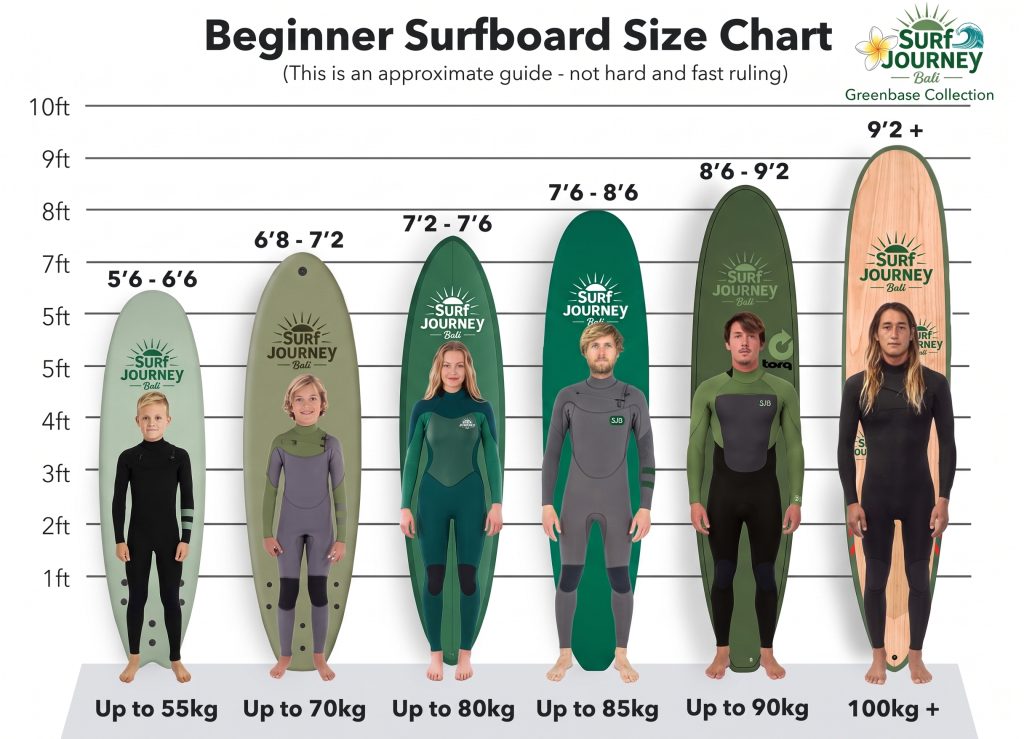
This is also exactly why advanced surfers ride far less volume than beginners at the same body weight — as skill develops, excess volume actually becomes a hindrance. It increases swing weight, stops the board from penetrating the surface during duck dives, and prevents the rail from fully engaging during a turn. Beginner and advanced volume needs aren’t just different by degree, they’re pulling in opposite directions for good technical reasons.
The Complete Volume Chart by Body Weight
This is the reference table worth bookmarking. It scales recommended volume across body weight and skill tier:
| Body Weight | Beginner Volume | Intermediate Volume | Advanced Volume |
|---|---|---|---|
| 77 lbs / 35 kg | 32 L | 22 L | 18 L |
| 88 lbs / 40 kg | 34 L | 23 L | 19 L |
| 99 lbs / 45 kg | 37 L | 24 L | 20 L |
| 110 lbs / 50 kg | 39 L | 25 L | 22 L |
| 121 lbs / 55 kg | 42 L | 26 L | 23 L |
| 132 lbs / 60 kg | 44 L | 27 L | 24 L |
| 143 lbs / 65 kg | 46 L | 29 L | 25 L |
| 154 lbs / 70 kg | 50 L | 31 L | 26 L |
| 165 lbs / 75 kg | 53 L | 33 L | 27 L |
| 176 lbs / 80 kg | 58 L | 35 L | 28 L |
| 187 lbs / 85 kg | 60 L | 37 L | 30 L |
| 198 lbs / 90 kg | 64 L | 43 L | 32 L |
| 209 lbs / 95 kg | 67 L | 43 L | 33 L |
| 220 lbs / 100 kg | 72 L | 45 L | 36 L |
| 231 lbs / 105 kg | 75 L | 48 L | 40 L |
| 243 lbs / 110 kg | 80 L | 50 L | 43 L |
Two patterns worth noticing: beginner volume climbs steadily and substantially with body weight — you can see it nearly doubling from the lightest to heaviest rows — while advanced volume climbs far more conservatively, since a skilled surfer’s technique compensates for a lot of what raw buoyancy does for a beginner.
If You’re Above 110 kg / 243 lbs
The table’s top row isn’t a hard ceiling, just the edge of standard reference data — the same proportional logic continues past it. If you’re heavier than 110 kg, look specifically for the highest-volume stock soft-top longboards available, which specialty and larger-rider-focused brands do produce well above 80 liters, or consider a custom shape order built explicitly around your weight. The priority at this end of the scale isn’t finding one magic number, it’s making sure length, width, and thickness are all working together rather than relying on one dimension to carry all the extra volume alone — more on exactly why that matters below.
Volume Isn’t the Only Variable — Shape Matters Too
A target volume number can technically be reached several different ways: a shorter, thicker board, or a longer board with more moderate thickness. For a beginner, and especially a heavier beginner, length is the better route.
A wide, long soft-top longboard in the 8 to 9-foot-plus range reaches high volume through surface area and a flat entry rocker, producing a stable, forgiving platform — rather than becoming an oddly thick, hard-to-paddle block trying to hit the same number in a shorter package. This is precisely why soft-top foam longboards remain the standard beginner shape regardless of body weight: they scale volume the right way.
Reading Rocker and Rails for a Heavier Frame
Two more shape details are worth understanding, since they compound with volume rather than replace it:
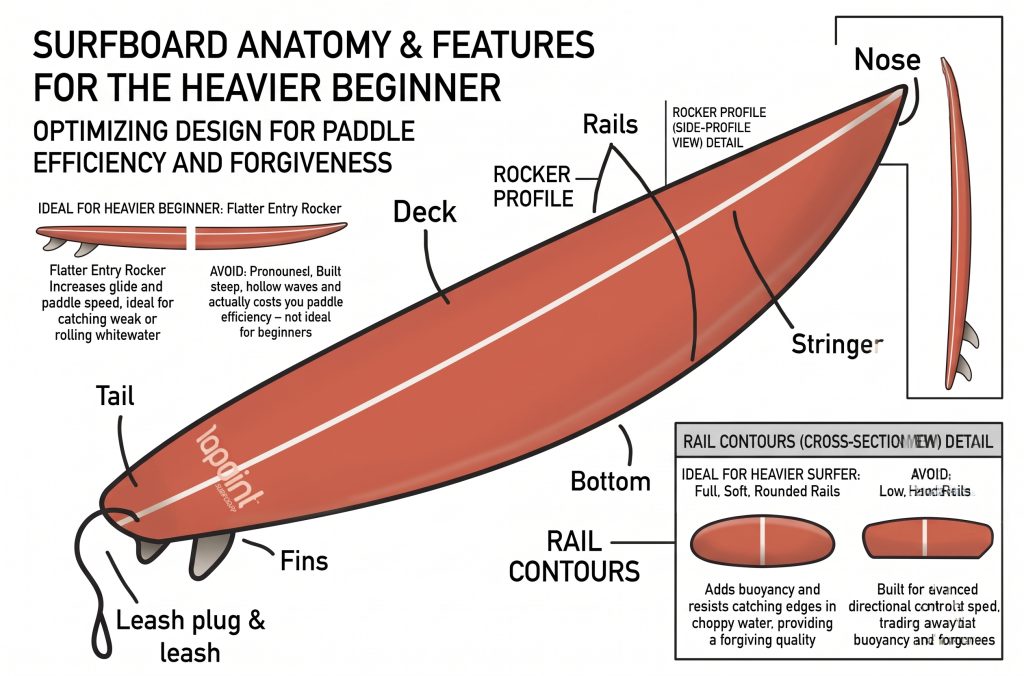
- Rocker profile — the curve of the board from nose to tail. A flatter entry rocker increases glide and paddle speed, exactly what you want for catching weak or rolling whitewater as a beginner. A more pronounced, curved rocker is built for steep, hollow waves and actually costs you paddle efficiency — not what a heavier beginner needs early on.
- Rail contours — the board’s perimeter edge. Full, soft, rounded rails add buoyancy and resist catching edges in choppy water, which is exactly the forgiving quality a beginner benefits from. Low, hard rails are built for advanced directional control at speed, trading away that buoyancy and forgiveness.
Both of these favor the same conclusion: a heavier beginner wants flat rocker and full rails working alongside high volume, not fighting against a board that’s technically buoyant enough on paper but shaped for a different rider entirely.
A Practical Example
Take a 100 kg (220 lb) beginner. The chart points to roughly 72 liters of volume. Reaching that number on a 6-foot board would require extreme, unrideable thickness — but a 9-foot soft-top longboard reaches 72 liters comfortably through its length and width alone, while staying easy to paddle, carry, and balance on. Same target number, completely different — and far more practical — path to get there.
When to Size Down
As your paddle fitness, prone trim, and pop-up consistency build — and once you’re reliably catching green, unbroken waves rather than just whitewater — it’s time to shift toward the intermediate volume column. That transition usually comes with a shift in shape too, moving toward a funboard or mid-length (roughly 6’8″ to 7’6″) that trades some of that beginner-stage forgiveness for real turning capability.
The Bottom Line
Volume isn’t a guess, and it isn’t something a heavier beginner needs to feel self-conscious about — it’s simply a number that scales with body weight the same way it does for every surfer. Match your weight to the right liters, choose a shape that reaches that number through length rather than awkward thickness, and the physics will do a meaningful share of the work for you.
Not sure exactly what volume you need? Tell us your weight and experience level when you book, and we’ll have the right board — correctly sized — waiting for you.

Yosua is a surf enthusiast with over 5 years of chasing waves across Bali’s iconic coastlines. From West coast to East coast of Bali, he’s spent years exploring what makes Bali one of the world’s greatest surf destinations. Through Surf Journey Bali, Yosua shares honest guides, local tips, and surf travel insights to help both beginners and seasoned wave-riders make the most of their Bali surf experience.