
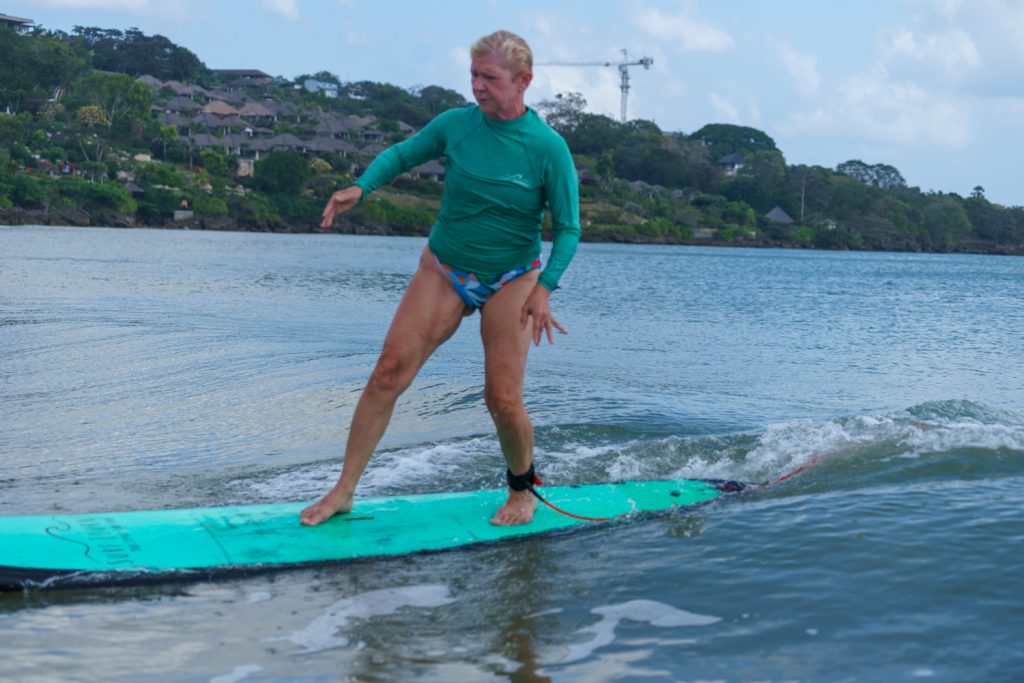
If you’ve been quietly wondering whether 40-something is too late to start surfing, here’s the honest answer: no, and it’s not close. This is one of the most common questions coaches hear from prospective clients, and it’s almost always followed by genuine surprise at how quickly the doubt disappears once they’re actually in the water.
The Short Answer, Backed by Real Numbers
Coaching centres around the world, teach beginners in their 40s, 50s, and 60s as a matter of routine, not exception. Across the industry, roughly 95% of adult first-timers manage to stand up during their very first coached session, regardless of age — and at some surf schools, more than 30% of guests are over 40. This isn’t a niche accommodation being made for older travelers. It’s simply who shows up to learn.
Why Surfing Is Genuinely Kind to a 40+ Body
Here’s something worth understanding properly rather than just taking on faith: surfing is a genuinely low-impact activity. Unlike running or basketball, where every step sends force through your ankles, knees, and hips, the water’s buoyancy supports your body weight throughout a session — you generate real power through paddling and popping up without the repetitive impact those other sports demand. It’s exactly why water-based exercise is so often recommended for people managing joint conditions or arthritis.
This lines up directly with why a proper warm-up matters so much before any session: priming the neuromuscular system and lubricating your joint capsules genuinely reduces injury risk, and it’s a habit worth taking seriously at any age, but particularly once recovery isn’t quite as instant as it used to be.
The One Honest Caveat
It wouldn’t be a fair guide without naming this clearly: adults over 40 generally do need more recovery time between sessions than a 20-year-old paddling next to them. Muscle soreness and joint fatigue linger longer, and that’s just physiology, not a personal failing. The fix isn’t to push through it — it’s to plan for it. Build rest days into a multi-day surf trip rather than stacking session after session, and don’t measure your recovery pace against someone half your age in the lineup. It’s simply a different rhythm, not a worse one.
The Advantages Age Actually Gives You
It’s easy to focus entirely on what feels harder and miss what’s actually working in your favor. Adults bring patience, discipline, and a more analytical approach to learning a new physical skill — qualities that genuinely accelerate early progress rather than slow it down. There’s also something less tangible but just as real: the life experience to know that being a beginner at something is simply part of learning it, not a source of embarrassment. A relaxed adult who’s genuinely fine falling off a hundred times often progresses faster than someone tying their self-image to looking competent immediately.
Why Private Coaching Is Worth It at This Stage
This is where the case for private coaching becomes less about luxury and more about genuine strategy. Choosing the right wave and conditions is the single most effective safety decision any adult beginner can make — a small, consistent, sandy-bottomed wave removes unpredictable variables and lets you focus purely on technique. In a group lesson, that break gets chosen for the average of the group. In a private lesson, it’s chosen entirely around you: your fitness level, your goals, and — importantly at this stage — your body’s actual recovery needs across a multi-day trip.
There’s a time efficiency argument here too. If you’re traveling with a limited window and want to make real progress rather than simply sample the experience, private coaching delivers more repetitions, faster technical correction, and a pace matched precisely to how your body is responding day to day — all of which matters more, not less, once recovery time is part of the equation.
Getting the Equipment Right
The same principle that applies to any beginner applies here, just worth restating: a bigger, higher-volume board is your friend, not a compromise. More buoyancy means less paddling effort to catch each wave and a more stable platform for finding your balance — which also means less unnecessary strain on a body that’s learning a genuinely new movement pattern for the first time in years, possibly decades.
A Simple Truth
Age turns out to be one of the smallest factors in whether someone learns to surf well. What actually matters is the coaching you get, the equipment you’re on, and whether you respect your own recovery rather than fighting it. Get those three things right, and 40, 50, or 60 is simply the age you happened to start — not a limitation you had to overcome.
Thinking about booking a private lesson? Tell us your fitness background and how many days you have, and we’ll build a pace and schedule that’s genuinely built around you.

Yosua is a surf enthusiast with over 5 years of chasing waves across Bali’s iconic coastlines. From West coast to East coast of Bali, he’s spent years exploring what makes Bali one of the world’s greatest surf destinations. Through Surf Journey Bali, Yosua shares honest guides, local tips, and surf travel insights to help both beginners and seasoned wave-riders make the most of their Bali surf experience.