
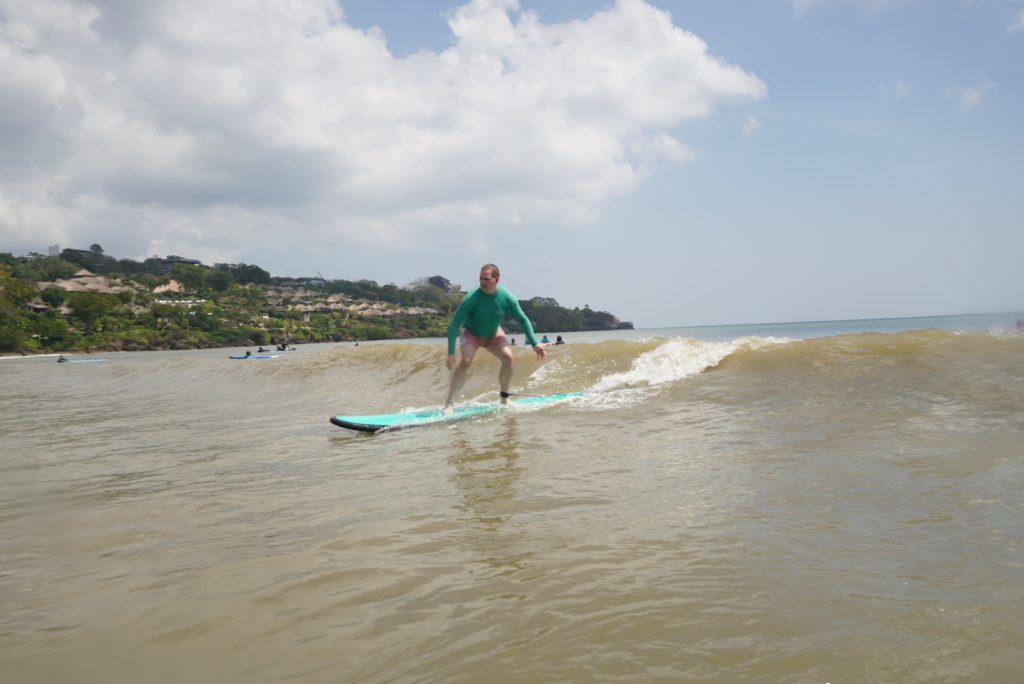
Jimbaran doesn’t have the reputation of Canggu or the Bukit’s cliff-top breaks, and that’s exactly why I send a lot of my more nervous students there. It’s one of the calmest, most protected stretches of coastline in Bali — and it actually has more than one good option once you know where to look. Here’s the full breakdown.
Why Jimbaran Is Worth Surfing
Jimbaran Bay is a deep, west-facing bay protected by outer coral shelves and headlands. That geography does something genuinely useful: it absorbs and dissipates ocean energy before it reaches the shore, which means the bay stays calm and workable even when the exposed Bukit Peninsula reefs nearby are firing at double-overhead. If you’re newer to surfing, traveling with someone who isn’t ready for bigger, more exposed breaks, or just want a reliably gentle session, Jimbaran is one of the best answers on the island.
The Spots Inside Jimbaran Bay
Jimbaran isn’t one single wave — it’s a bay with a few distinct, beginner-friendly options depending on which part of the shoreline you’re on.
Jimbaran Beach (the general bay setup)
This is the bay’s overall character: a sheltered setup producing safe, low-energy inside rollers even when outer swell is running a healthy 4–8 ft. It’s rated Beginner, works best in the dry season, and is at its best from mid to high tide.
Muaya Beach (south end of the bay)
Muaya sits at the southern end of Jimbaran Bay and is specifically noted as a protected retreat for nervous learners and first-time paddlers. It produces a soft, spilling shorebreak over fine sand with minimal sweep — very little sideways current to worry about. Rated Beginner, dry season, and best specifically at high tide.
Kelan Beach (north end of the bay)
Kelan sits at the northern end, featuring an even, flat sandy bottom with calm lines rolling parallel to the Ngurah Rai airport runway. It’s described as a forgiving platform for early pop-ups — genuinely built for the earliest stages of learning. Rated Beginner, dry season, best from mid to high tide.
In short: if one end of the bay isn’t quite working on a given day (wind angle, a few extra people in the water, whatever the reason), the other end is worth checking. Muaya and Kelan give you two separate, similarly gentle options inside the same protected bay.
Want More Challenge? Airport Reefs, by Boat from Jimbaran
If you’ve built up your skills and Jimbaran’s inside rollers start feeling too easy, Jimbaran Bay also serves as the launch point for the Airport Reefs — reached by outrigger boat rather than a beach walk-in. The main named wave here, Toro Toro, is a soft, rolling right-hand shoulder over an outer reef pass in deeper water, rated Intermediate. It’s notably free of the heavy, critical ledges you’d find at Bukit cliff breaks like Bingin or Padang Padang, which makes it a smart, lower-consequence step up once you’re ready to start reading reef waves. Swell here typically runs 4–8 ft (SW), best from mid to high tide, dry season.
This gives Jimbaran a genuinely useful range: gentle sand-bottom bay surf for beginners right off the beach, and a boat-accessible reef pass nearby for when you’re ready for more.
Best Season and Tide for Jimbaran
Across all of Jimbaran Bay’s beginner spots, the pattern is consistent:
Who Jimbaran Is Best For
What Board Should You Bring to Jimbaran?
A soft-top or foam longboard is the right call across every beach in the bay. The gentle, low-energy nature of these waves means the extra volume and stability do most of the work for you — this is exactly the kind of environment where a bigger board lets you focus purely on technique.
Getting There
Jimbaran Bay is on Bali’s southwest coast, easily accessible from South Bali generally and a short trip from the Jimbaran area itself. Muaya sits toward the south of the bay, Kelan toward the north — both are close enough together that checking one, then the other, is a reasonable plan if conditions call for it.
Final Word from Your Coach
Jimbaran’s biggest strength is that it takes the guesswork and anxiety out of learning to surf — the bay does the hard work of taming the ocean for you. Whether you land at Muaya, Kelan, or just the general bay setup, you’re getting one of the most forgiving, genuinely beginner-built stretches of coastline Bali has to offer, with a boat ride to real reef surf waiting nearby once you’re ready for it.
Planning a Jimbaran session, or not sure whether Muaya or Kelan suits you better on a given day? At Surf Journey Bali, we know this bay well and can put you in exactly the right spot for a calm, confidence-building first — or next — session.

Yosua is a surf enthusiast with over 5 years of chasing waves across Bali’s iconic coastlines. From West coast to East coast of Bali, he’s spent years exploring what makes Bali one of the world’s greatest surf destinations. Through Surf Journey Bali, Yosua shares honest guides, local tips, and surf travel insights to help both beginners and seasoned wave-riders make the most of their Bali surf experience.