
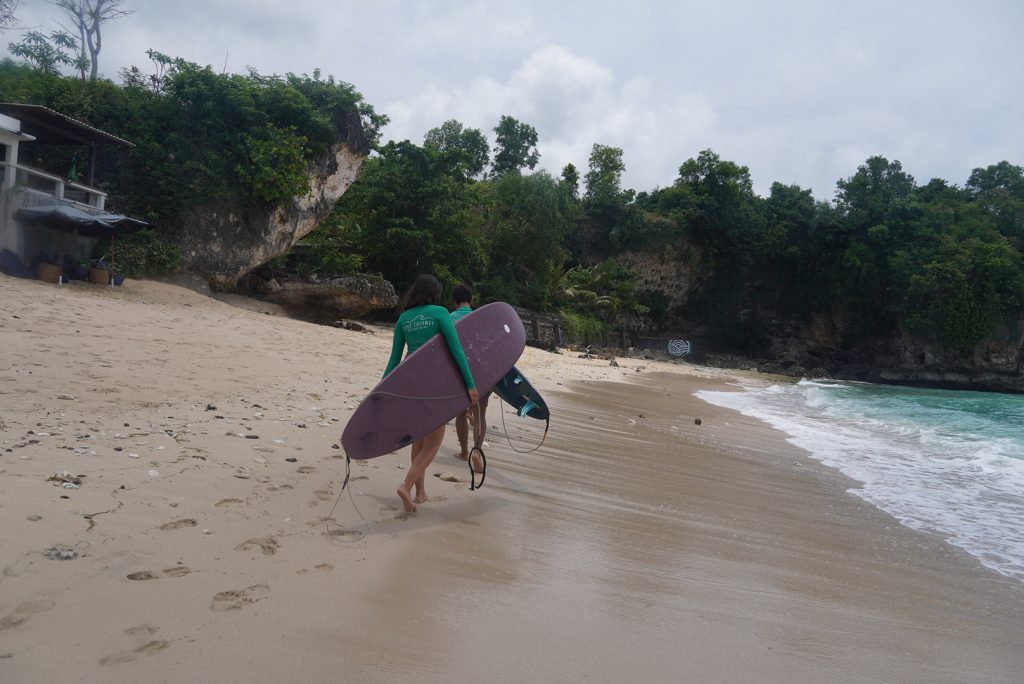
It’s the question almost every first-time visitor asks before booking: “How many lessons will I actually need?” The honest answer is that it depends on your goal — standing up for the first time is a matter of hours, while surfing with any real control is a matter of consistent practice over days and weeks. Here’s a realistic breakdown of what to expect at each stage, so you can plan an itinerary that actually matches your goals.
Day 1–2: Standing Up on Whitewater
This is the fastest milestone in surfing, and it’s genuinely achievable on day one. Your first sessions are spent on a soft-top longboard in the whitewater at a forgiving beach break like Kuta or Seminyak, where the wave energy is gentle and the sand bottom removes any real consequence from falling. Most beginners are standing up — even briefly — within their first one or two sessions, once the pop-up movement (hands down, hips and feet driving forward in one motion) starts to click.
What you’re really building in these first couple of days isn’t style, it’s timing: knowing when to start paddling, when the wave has “caught” the board, and when to spring up. It’s a foundational motor pattern, and like any new movement, it takes repetition to feel automatic rather than rushed.
Day 3–5: From Whitewater to Green Waves
This is where the real work of learning to surf begins. Once whitewater pop-ups feel comfortable, the next stage is catching unbroken (“green”) waves and angling the takeoff along the face, rather than riding straight to shore. Breaks like Batu Bolong in Canggu or Baby Padang on the Bukit — both known for slow-rolling, forgiving waves over a deep reef or sand bottom — are ideal for this transition, since they give you time and space to feel the board respond underneath you.
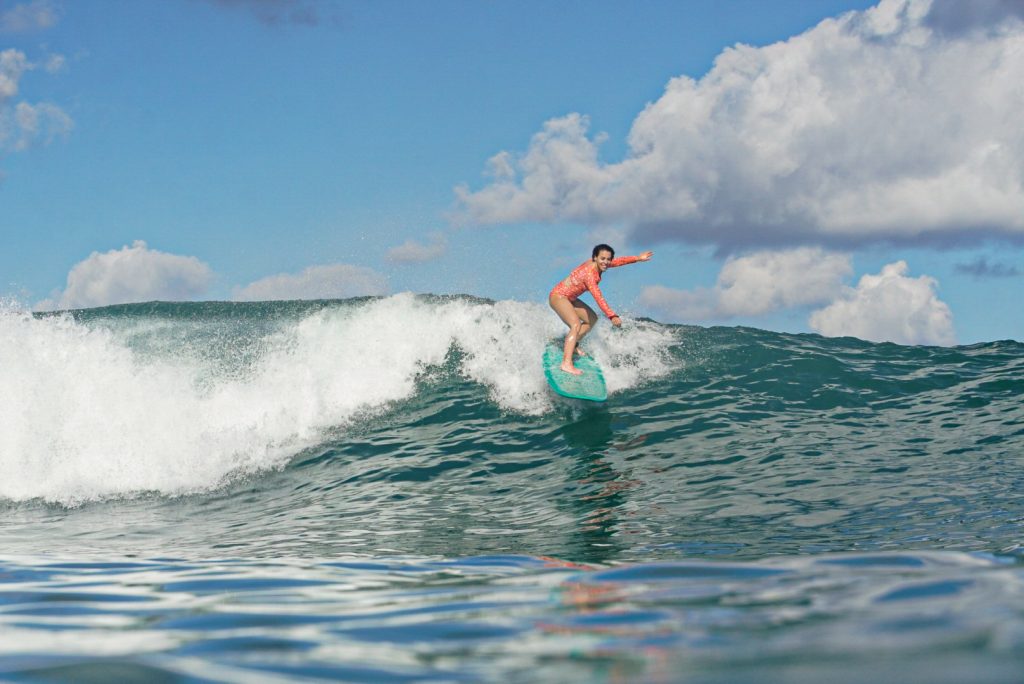
By day four or five of consistent practice, most surfers are catching green waves independently, holding a basic trim line along the wave face, and starting to feel what it means to generate speed rather than just ride straight in.
Week Two: Where Turning and Positioning Begin
If you have a full week or more, this is when surfing starts to feel like surfing rather than balancing. The technical centerpiece here is the bottom turn — the compress, reach, hold, and twist sequence that converts the speed of dropping down a wave face into a controlled turn along it. This maneuver is genuinely difficult to rush; it requires enough board comfort that you’re not thinking about balance anymore, freeing up attention for rail control and body rotation.
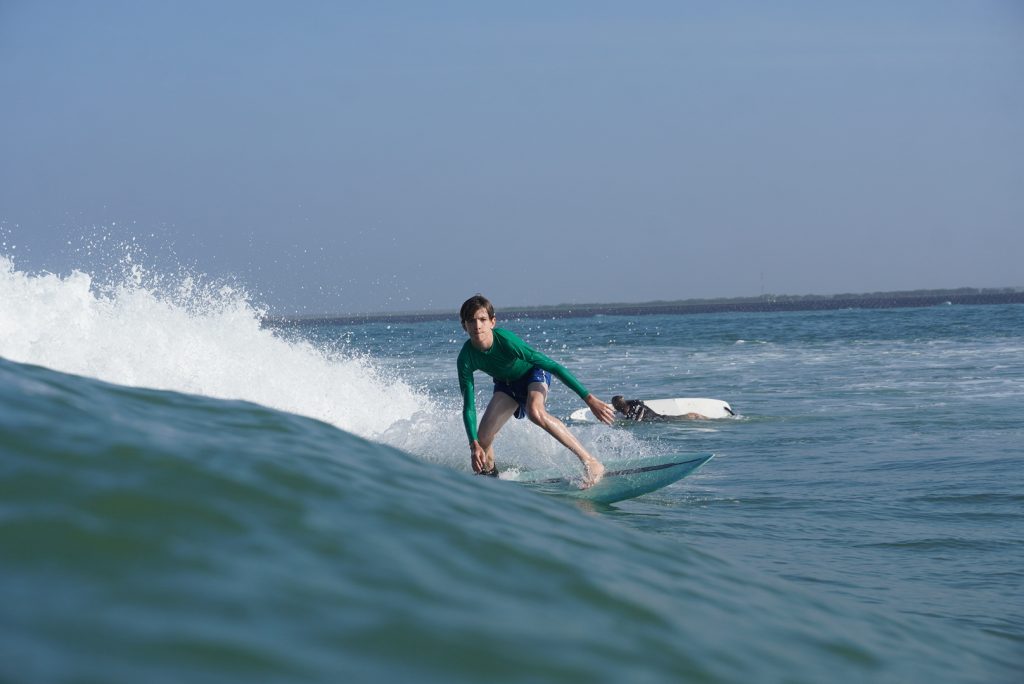
At this stage, boards typically transition too — from a big, buoyant longboard toward a funboard or mid-length, which still paddles easily but allows the rail-to-rail movement a bottom turn requires. Breaks like Medewi Point or the mellower sections of Balangan give the longer, more open wave faces needed to actually practice this.
Why Consecutive Days Matter More Than Total Lessons
Here’s the part that surprises a lot of visitors: five lessons spread across two weeks will generally produce slower progress than five lessons taken on five consecutive days. Surfing is a motor-skill sport, and motor skills are built through tight repetition — your body needs to “remember” what a wave felt like yesterday while it’s still fresh, rather than relearning the timing from scratch each session. Coaches often use land-based drills like surf-skating between water sessions for exactly this reason: it reinforces the same movement patterns without waiting on the ocean, accelerating how quickly the muscle memory locks in.
Practically, this means a tourist who books one lesson a day for five straight days will almost always leave a stronger surfer than one who books five lessons scattered across ten days of a longer holiday.
Setting Realistic Expectations Beyond One Trip
It’s worth being honest about the ceiling of a single trip: true surfing proficiency — reading swell and tide conditions independently, surfing steeper reef breaks, linking multiple turns together — typically takes months or years of regular water time, not a single vacation. That’s not a discouraging fact, though. Most visitors don’t need to reach that level to have an incredible, genuinely rewarding week of surfing. The goal of a Bali trip is usually to leave having gone from “never stood on a board” to “caught and rode real waves with control” — and that milestone is absolutely reachable in a week to ten days of consistent lessons.
Planning Your Bali Itinerary Around This
If your main goal is simply to try surfing and enjoy the experience, two or three days is enough to stand up, get comfortable, and have genuine fun in the whitewater. If you want to leave having made real progress — catching green waves, starting to turn, feeling like an actual surfer rather than a tourist who tried it once — plan for five to seven consecutive days minimum. If you’re aiming to walk away with a bottom turn and the start of wave-reading instincts, block out a full one to two weeks.
Whatever timeframe you have, the single biggest lever for progress isn’t talent — it’s consistency. Multi-day packages that stack sessions back-to-back will get you further, faster, than the same number of lessons stretched thin across your trip. Not sure how many days fits your goals? Tell us how long you’re in Bali and what you’re hoping to walk away with, and we’ll help you build a package that actually gets you there.

Yosua is a surf enthusiast with over 5 years of chasing waves across Bali’s iconic coastlines. From West coast to East coast of Bali, he’s spent years exploring what makes Bali one of the world’s greatest surf destinations. Through Surf Journey Bali, Yosua shares honest guides, local tips, and surf travel insights to help both beginners and seasoned wave-riders make the most of their Bali surf experience.