
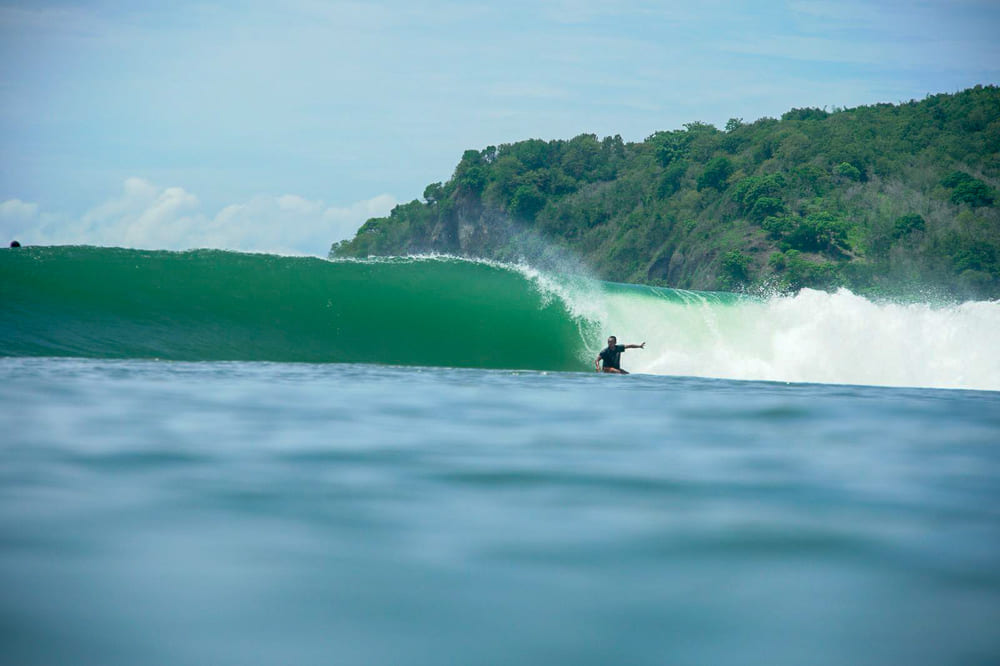
Ask any well-traveled surfer to name Indonesia’s most legendary wave, and there’s a good chance G-Land comes up before anything in Bali itself. Tucked into Grajagan Bay on the southeastern tip of East Java, this multi-section left-hand reef has been a proving ground for serious surfers since the 1970s. It’s not a Bali spot, and it’s not a beginner one either — but if you’re building toward it, here’s exactly what you need to know.
Where Is G-Land, and How Do You Get There?
G-Land sits deep inside Grajagan Bay on the edge of Alas Purwo National Park, East Java — a genuinely remote setting surrounded by jungle rather than the beach clubs and warungs you’ll find around Bali’s coastline. It’s roughly 87 km from Denpasar Airport as the crow flies, but the actual journey is by water: most surfers arrive by speedboat, a trip of around two hours from Benoa Harbour in Bali. A slower, more budget-friendly overland route also exists — ferry across to Java followed by a car or bus journey to Grajagan — though it takes considerably longer and eats into your trip.
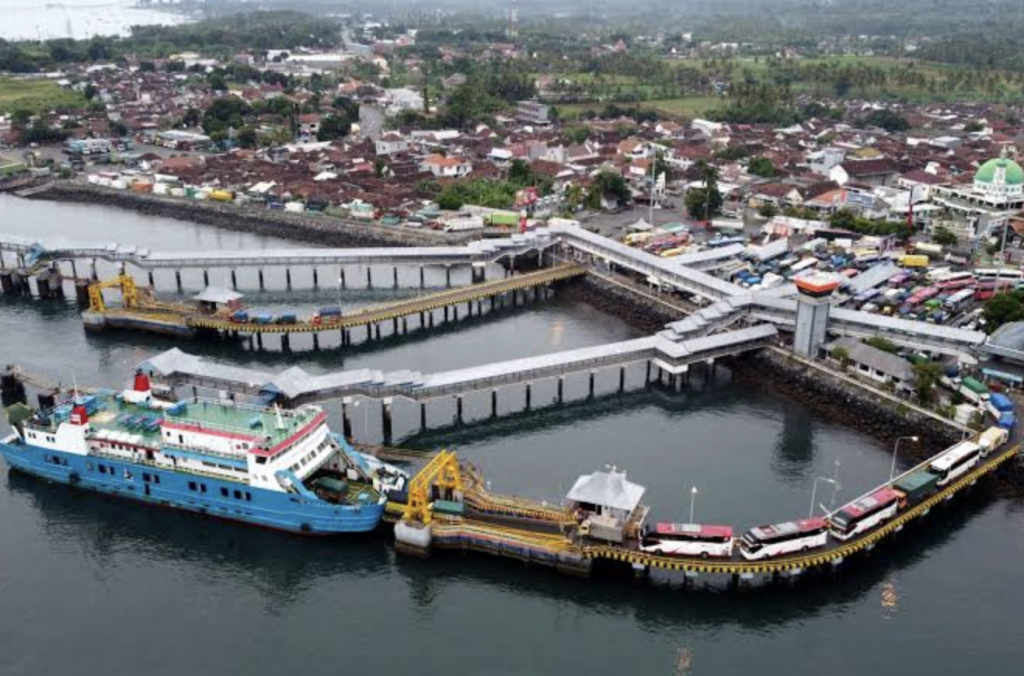
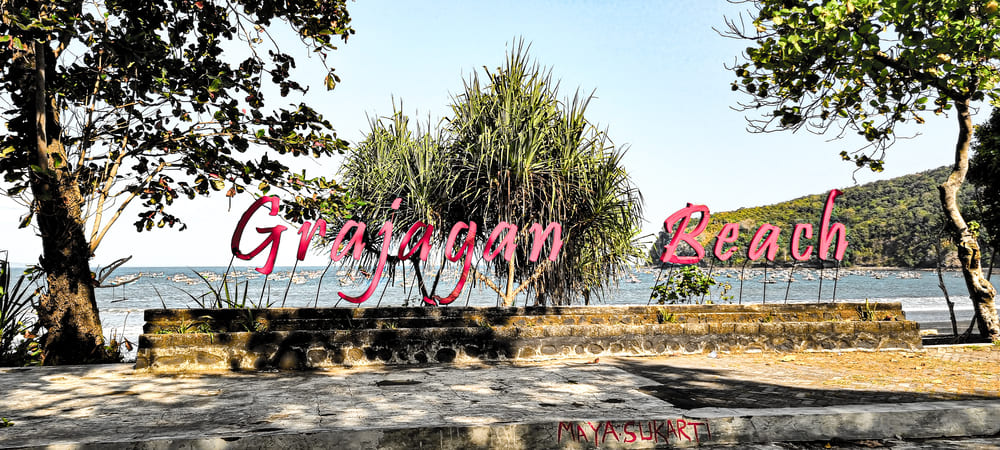
Because of that remoteness, this isn’t a day-trip destination the way many Bali breaks are. Surfers typically stay at one of the surf camps on site, or aboard a boat charter anchored in the bay, for a multi-day stretch.
Why This Wave Is Legendary
G-Land isn’t one single wave — it’s a long, bending reef shelf that wraps around the bay and produces several distinct left-hand sections depending on swell, tide, and how far along the reef you paddle. The waves here are widely regarded as more powerful and shiftier than almost anywhere else in Indonesia, a reputation earned since the wave first appeared in surf magazines and made its way onto the global map in the early 1980s.
Breaking Down the Sections
Understanding G-Land means understanding it’s a progression along the reef, not a single peak:
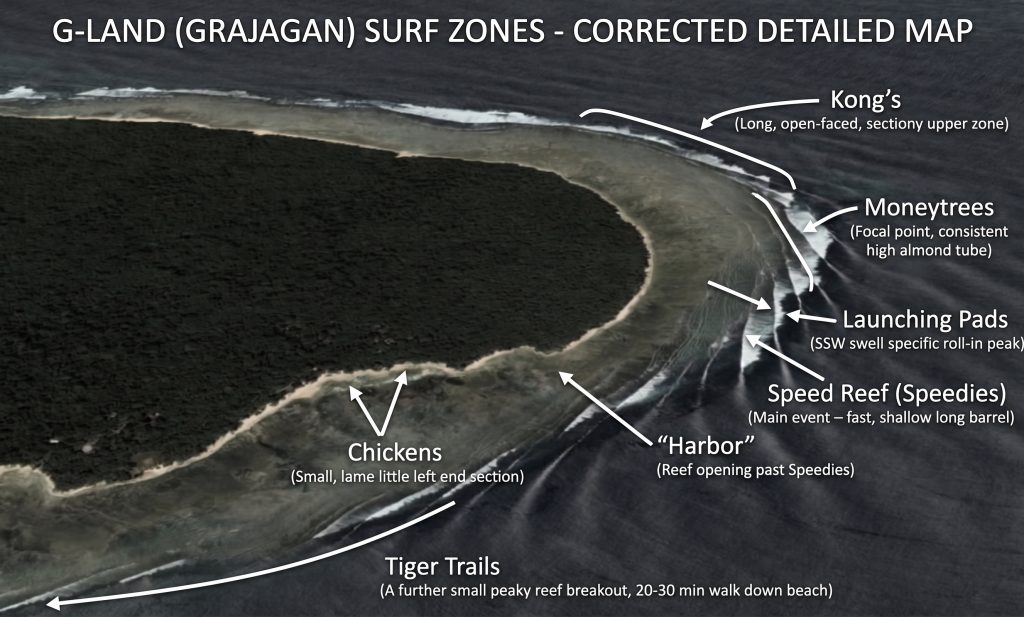
Image and detail by Surfline, annotation edit by Surf Journey Bali
- Kongs: The outermost section, farthest up the reef. Softer and more workable than what’s further in, this is the natural starting point for exploring G-Land — the same logic as building up through Bali’s beach breaks before tackling somewhere like Uluwatu. Under good conditions it can still open up into barrels running 300 meters or more.
- Money Trees: The main event, and the section that put G-Land on the map. Clean, long, fast, hollow barrels that work best on a southwest swell. If it’s your first session here, the standard advice holds: watch the experienced surfers first, avoid low tide, and commit to dropping in deep rather than hesitating.
- Speedies: The inside zone, and the most demanding of the three — tight, shallow, ledging barrels that offer little room for error. This section is squarely for advanced surfers only.
Best Tide, Swell, and Wind
Mid-tide is generally the sweet spot at G-Land, offering the best wave shape with less rip current pulling through the lineup. Low tide exposes more of the reef, which sharpens the danger considerably, while high tide tends to soften the wave’s punch. A useful rule many G-Land regulars follow: paddle out at high tide, and if you need to walk any section of reef, do it carefully at low tide and always in reef booties.
Southwest or south-southwest swell, combined with offshore wind from the east or southeast, produces G-Land’s best conditions — and the trade winds here are famously reliable, swinging offshore most days of the season by around mid-morning.
Best Season to Go
The dry season, roughly April through October, is prime time, with the June-to-September stretch delivering the highest consistency of clean, well-overhead swell. Average water and air temperatures sit around a warm 28°C (82°F) throughout. December and January are generally considered no-go months as the wet season takes hold, and the shoulder months of March and November bring more unpredictable, shifting winds.
A Timing Principle That Travels With You
If you’ve surfed in Bali, this next part will sound familiar. The same daily thermal wind cycle that governs when Bali’s breaks are glassy versus choppy applies at G-Land too: conditions are typically cleanest and least crowded in the early morning or late afternoon, before or after the trade winds and midday crowds build. It’s the same dawn-patrol logic worth applying anywhere in Indonesia — arrive early, and you’ll often get the wave at its best and least contested.
Who Should Surf G-Land
This isn’t a spot to learn the fundamentals — it’s where advanced surfers go to test themselves. If you’re still working through pop-up consistency or your first green waves, G-Land isn’t the place, and that’s not a knock, it’s just physics: powerful, hollow reef breaks like this punish hesitation and reward precise, practiced technique. The equipment matches the wave too — this is performance shortboard territory, a long way down the road from the soft-top longboards beginners start on. If you’ve progressed through Bali’s beach breaks and reef breaks and are chasing something more serious, G-Land is the natural next step.
Safety and Hazards
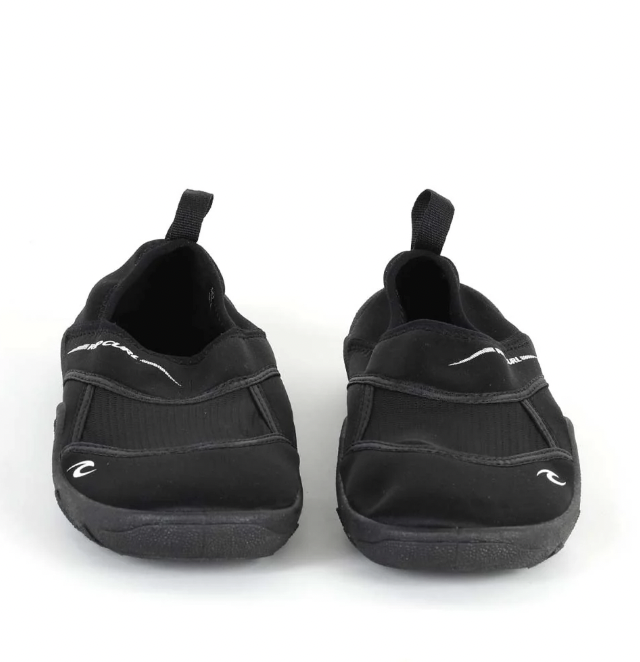
G-Land demands real respect. The reef here is sharp, shallow in places, and a common source of cuts — reef booties with a reinforced sole are genuinely worth packing, not just a nice-to-have. Urchins hide in the reef crevices, small sea snakes move through the channels, and strong currents and rips are a regular feature of the lineup, so knowing your position at all times matters. The setting itself is remote jungle wilderness, complete with wild monkeys and, notably, a malaria risk — it’s worth speaking with a healthcare provider about precautions well before you travel.
Crowd behavior matters more here too, not less. When G-Land is firing, the lineup fills quickly, and on a wave this powerful, the basic etiquette that applies everywhere — respecting priority, never dropping in on a rider already on the wave, holding onto your board — becomes a genuine safety issue rather than just good manners.
Planning the Trip
Because G-Land is a multi-day expedition rather than a single lesson, the same principle that applies to skill progression elsewhere applies here too: consecutive days in the water build both comfort with the reef and the physical conditioning this wave demands. Paddling here is more taxing than a typical beach break session, so arriving with decent paddling endurance — and warming up properly before every session — genuinely pays off on a wave this demanding.
The Bottom Line
G-Land isn’t a beginner detour from your Bali trip — it’s the destination serious surfers build years of practice toward. Remote, powerful, and genuinely world-class, it rewards those who arrive prepared, respect the reef, and time their sessions around the same wind patterns that govern good surf anywhere in Indonesia.
Thinking about progressing toward a trip like this? Talk to us about your current level and timeline, and we’ll help you build a realistic path from where you are now toward a wave like G-Land.

Yosua is a surf enthusiast with over 5 years of chasing waves across Bali’s iconic coastlines. From West coast to East coast of Bali, he’s spent years exploring what makes Bali one of the world’s greatest surf destinations. Through Surf Journey Bali, Yosua shares honest guides, local tips, and surf travel insights to help both beginners and seasoned wave-riders make the most of their Bali surf experience.